
Why Companies in Turkey Should Use a CFO Agent
A "CFO agent" is not a program you buy; it is an AI assistant that works beside the finance team every day, reads from the ERP, spots the variance, prepares the draft and brings it to a person for approval. Large companies abroad have started using it; I described in another article how OpenAI's own finance team hands its monthly close and quarter-end checks to an agent. This article asks a different question: why is this assistant a need rather than a luxury for a manufacturing or trading company in Turkey?
Four things that make Turkey different
The agent idea is universal; the conditions that make it urgent in Turkey are local.
1. Numbers have a short shelf life. In an economy with high inflation and a volatile currency, last month's cost is the wrong reference for this month's price. Sales quotes from an old price list, purchasing budgets at an old rate, and finance sees the gap at month end. A weekly report is late at this speed; something has to see the variance during the day. The agent's most valuable property is not its intelligence but the fact that it never sleeps.
2. The rules change often. Inflation accounting was applied in 2024; a law passed in December 2025 suspended it for the 2025, 2026 and 2027 fiscal years and gave the President the authority to extend the suspension by three more periods. The scope of e-invoice, e-archive and e-ledger widens year by year, with ledger certificates uploaded on a fixed calendar. The finance team works under a new rule every year. For an agent this is both a reason and a warning: an assistant that follows the rule takes work off the team, but when the rule changes the agent's rule must change too; an agent that keeps working "the way it was last year" makes the most expensive mistake.
3. Collection is not a process but a chase. Post-dated cheques and notes, dealer terms, partial payments and offsets turn receivables management in Turkey into a daily job. In most companies that chase lives in one person's spreadsheet and memory. An agent that lists the overdue, the due-soon and the over-limit customer every morning and reminds the owner does not replace that person; it replaces their memory.
4. The finance team is small and credit is tight. In a mid-sized company finance is two or three people, the accountant is external and reporting still lives in Excel. At the same time access to credit is managed by policy: in early October 2026 the central bank raised the growth cap on SME loans, which is to say credit is still rationed. A company that sees its cash forecast two days late borrows two days late. The cheapest capacity a small team can add is to hand over the repetitive chasing.
What a CFO agent does
Let it be concrete; the agent's week in a manufacturing company:
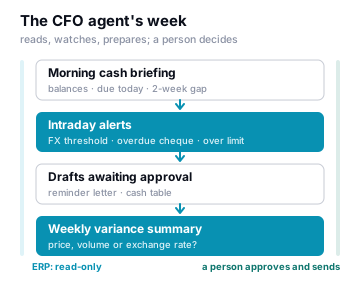
- Morning cash briefing. Bank balances, payments and collections due today, the gap or surplus for the next two weeks. Three sentences, one table, at eight o'clock.
- Intraday alerts. Orders with open exposure when the exchange rate crosses a set threshold; an overdue cheque; a customer over limit; a purchase request over budget. The alert goes to the person responsible; the agent does not decide.
- Drafts awaiting approval. A reminder letter to a customer, a cash table for the bank, a variance note for management. The agent prepares the draft; the owner corrects and sends it.
- Weekly variance summary. The source of the difference between budget and actual: price, volume or exchange rate? The agent separates them; a person writes the commentary.
Notice what is not on the list: the agent does not write records to the ERP, does not send payments, does not change prices. That is not a limit of capability but a setup decision, the principle we describe on our security page. The glossary terms human-in-the-loop, principle of least privilege and agent hooks describe the three legs of that setup.
Where the world is, and where we are
Surveys from abroad should be read with care; most come from software vendors. In Wolters Kluwer's May 2025 survey, six percent of finance leaders said they use agents and thirty-eight percent planned to start within twelve months. In PYMNTS's smaller September 2025 study with finance chiefs of large US companies, about one in ten were using or piloting; none allowed full autonomy, and the first application areas were planning and reporting. So the world, too, works within the "agent produces, person approves" frame and starts from reporting. A company in Turkey is not behind; it is at the same starting point, under harsher economic conditions.
Where to start
Three steps, three months:
- One briefing. Set up the morning cash briefing. Read-only data from the ERP and the bank, one template, one recipient. Compare it with the human-made version for a month.
- One alert. The overdue collection alert. Who receives it, at which threshold, through which channel. Measure the number of alerts and the collection time; do not say "it got faster" without measuring.
- One draft. The customer reminder letter. The agent writes, the sales owner approves. If the approval rate is high, move to the second draft.
At every step the data boundary must be in writing: which tables, which fields, whether personal data is involved, whether the model runs locally or in the cloud. Turkey's personal data protection law and trade secrets demand the answer at the start of the project.
Where ERPware stands
What we offer today is the layer the agent reads from: asking the ERP questions in plain language with Kai, and watching indicators continuously with ErpwareBI. The agent layer that produces alerts and drafts is on our roadmap; we build it with customers as pilots, in the order above and with human approval at every step. "Without replacing your ERP" applies here too: a CFO agent is not a new finance system but an eye and a pen placed on top of the ERP you already have.
Sources
- Official Gazette (Turkey), 25 December 2025, no. 33118 — Law no. 7571, article 34 (Tax Procedure Law, provisional article 37): no inflation adjustment for the 2025, 2026 and 2027 fiscal years; summaries in the ISMMMO note and CNBC-e report.
- Turkish Revenue Administration, e-Ledger — official announcements on scope and certificate upload calendar.
- Borsa Gündem, Şimşek: supporting the financial system and the real economy, October 2026 — the growth cap on SME loans raised.
- Wolters Kluwer, Finance leaders plan to increase agentic AI adoption, May 2025 — vendor survey, self-reported figures.
- PYMNTS Intelligence, AI Agents in the Enterprise, September 2025 — interviews with 60 CFOs; autonomy and priority findings.
- ERPware, How OpenAI's products are used in financial services and How to automate financial reporting with Codex — OpenAI finance team's own account and a step-by-step setup.
Regulatory information in this article is general; consult your accountant and the Revenue Administration's current announcements for application. Survey figures are the organisations' own statements.